How electrical estimators can win more tenders without increasing workload
Estimating best practices

Most electrical estimators are not losing tenders because their pricing is wrong. They are losing them because they cannot get enough tenders out the door, or because time pressure forces trade-offs between speed and accuracy that undermine the quality of their bids.
Winning more tenders does not always mean working more hours. It means removing the friction that slows the estimating process down.
In a competitive tender environment, response time is a commercial variable not just an operational one.
Estimators who can turn around accurate estimates quickly can take on more opportunities without adding headcount. They can respond to late-stage tender invitations that others cannot resource. They can spend more time on commercial review and value engineering, which improves both pricing quality and win rate.
Speed matters for another reason: clients notice. An estimating team that consistently submits on time with well-structured, detailed documentation builds a reputation for reliability that influences award decisions beyond the numbers alone.
The constraint for most electrical estimating teams is not ambition. It is time. And the question worth asking is where that time is actually going.
Before you can improve throughput, you need to understand what is slowing it down. In most electrical estimating workflows, the same bottlenecks appear repeatedly.
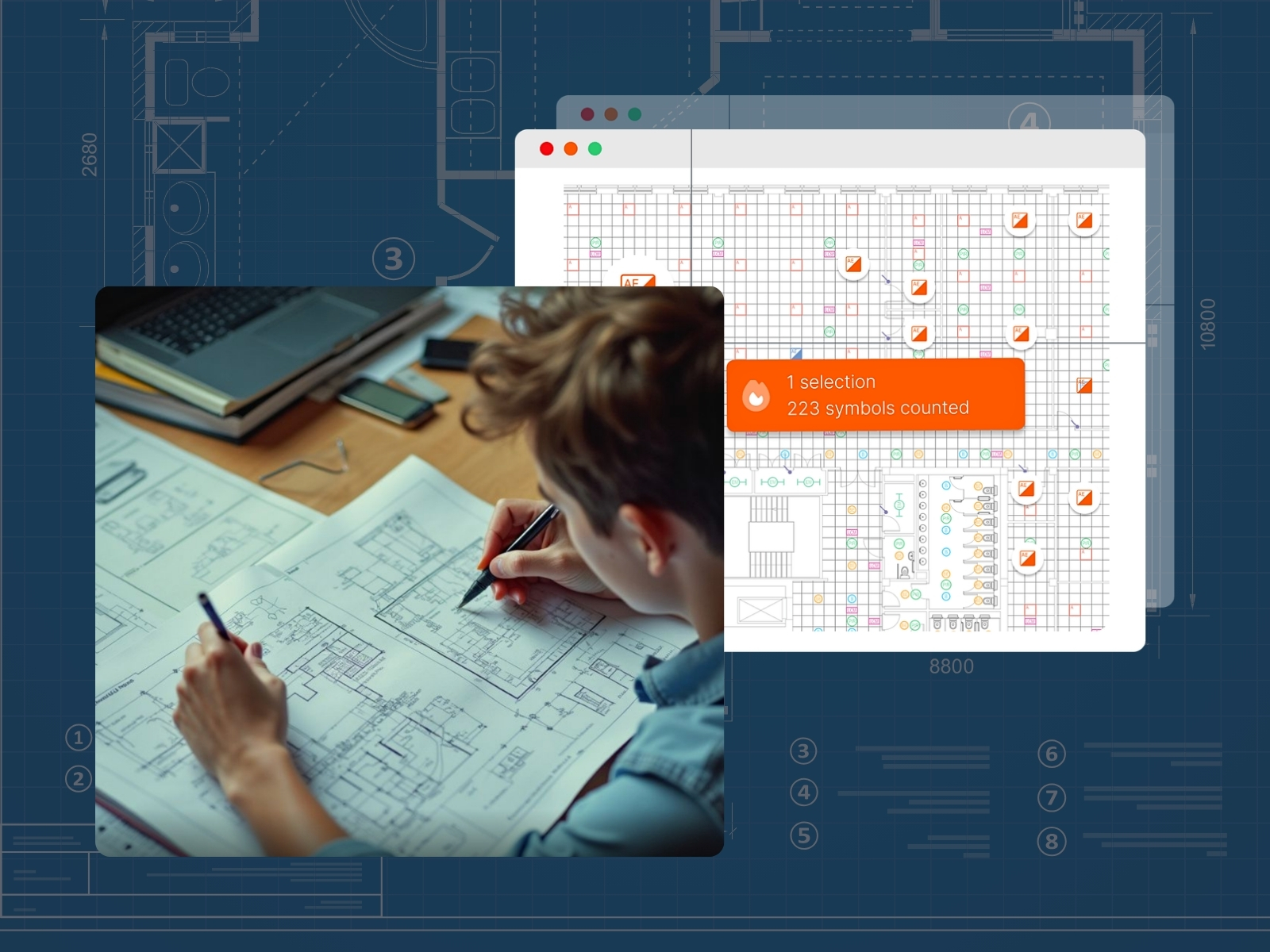
Symbol counting is the most time-intensive part of the takeoff process and the part that adds the least value. An estimator working through a set of commercial drawings manually can spend a full day or more on a single project, tallying symbols that a software tool could process in minutes.
That time cost is not just about the hours spent counting. It is about what those hours are not being spent on: reviewing supplier pricing, sense-checking the build programme, identifying risk items in the specification, or pricing the next opportunity in the pipeline.
Manual counting also scales poorly. As project complexity and drawing set size increase, the time required grows but the tender window does not.On a 200-drawing commercial project, that's potentially two full days of a senior estimator's time spent just on counting
Revised drawings issued late in a tender period are a near-universal source of disruption. With a manual workflow, a late revision can require a partial or full re-count, cutting into the time available for pricing review and submission preparation.
For companies managing multiple active tenders simultaneously, a revision on one project can create a bottleneck that affects everything else in the pipeline.
When takeoff data, pricing spreadsheets, supplier quotes, and specification documents live in different places, such as email threads, local drives, and individual files, assembling a complete picture of any single tender requires significant coordination overhead.
Jamie, Company Director at Minlec, knows this well. Before switching to automation, his process was entirely manual: printing every inquiry, working through drawings with highlighter pens, and counting by hand. "It was laborious, time consuming and wasteful," he says. The result was a business that consistently struggled to meet client deadlines through lost time in the process itself.
Estimators in this position spend their hours locating information, reconciling versions, and confirming whether the drawing they are pricing against is the current issue. That coordination overhead is invisible in most workflow analyses, but it accumulates to a significant proportion of total estimating hours. For many companies, consolidating that process into a single platform had an immediate impact: hitting deadlines became the norm rather than the exception.
Faster turnarounds do not require cutting corners. They require removing the steps in your process that consume time without improving the quality of the output.
The most direct route to faster takeoffs is removing the manual counting task. Automated takeoff software scans drawings and returns symbol counts in a fraction of the time required for manual tally with every instance flagged on the drawing for verification.
For a team that currently allocates two days to a commercial takeoff, reducing that to a few hours creates capacity. That capacity can be used to price more tenders, to review existing ones more thoroughly, or simply to protect estimator bandwidth during busy periods.
Automation also reduces the revision problem. When a drawing is reissued, a re-run of the count takes minutes rather than hours which means late revisions are manageable rather than disruptive.
One of the less visible time costs in estimating is rebuilding pricing frameworks from scratch on each new tender. When material rates, labour outputs, and preliminary structures have to be reassembled every time, significant hours are consumed in setup rather than pricing.
A standardised pricing structure with maintained rate libraries, regularly updated material costs, and consistent labour output assumptions removes that setup overhead. Estimators begin from a reliable baseline and adjust for project-specific factors rather than starting from zero.
This also improves consistency across tenders, which makes quality control faster and more reliable.
Historical estimate data is an underused asset in most electrical estimating functions. Previous projects contain validated material quantities, accurate labour assessments, and lessons learned on risk items, all of which are relevant to pricing similar future work.
Companies that build a searchable library of past estimates can significantly reduce the time spent on new tenders with comparable scope. Rather than deriving every figure from first principles, estimators can benchmark against comparable completed projects and adjust for differences.
This is exactly how Kyle, Managing Director at Safezone Electrical, now approaches estimating. After switching to automation, he no longer needs to manually search through old projects for reference figures as past data is pre-populated automatically, and the software learns his pricing patterns over time. "The more you use it the better it gets," he says. "Much simpler than using a spreadsheet for estimates."
This approach also improves accuracy: figures derived from actual project data are more reliable than those built from reference tables alone.
The relationship between speed and volume is straightforward: if a tender that currently takes five days takes two, you can price two and a half times as many opportunities with the same resource.
But the benefit is not purely quantitative. Faster takeoffs create optionality. With more time available, estimating teams can be selective, focusing capacity on the tenders most likely to convert, rather than pricing everything that arrives regardless of fit.
They can also engage more substantively with the work they do price. Time spent on supplier negotiation, subcontractor comparisons, and commercial risk review directly improves the quality of the bid. A well-priced, well-documented tender from a contractor who clearly understands the scope is more compelling than one that appears rushed, even if the bottom-line number is similar.
Speed, in other words, creates the conditions for better commercial decisions, not just more of them.
A common concern about faster estimating is that speed comes at the cost of accuracy. In practice, the relationship is the opposite when the right process is in place.
Manual counting is both slower and less accurate than automated counting. Standardised pricing structures are both faster to apply and more consistent than bespoke frameworks rebuilt each time. Centralised, version-controlled project data is both quicker to navigate and less likely to produce errors than files distributed across email and local drives.
The accuracy improvements come from removing the human-error-prone steps, manual counting, spreadsheet assembly, and version management, rather than from spending more time on them. Faster and more accurate are not in tension; they are achieved by the same process changes.
The estimator's time is best spent on the decisions that require judgement: assessing programme risk, reviewing specification ambiguities, positioning the bid commercially. None of those tasks benefit from manual symbol counting. All of them benefit from having more time available.
Cloud-based estimating platforms address several of the bottlenecks described above simultaneously.
By centralising project data including drawings, counts, pricing, and documentation in a single accessible location, they eliminate the version control and coordination overhead that consumes time in distributed workflows. Every team member is working from the same source, with the same current information.
Cloud access also means estimating work is not tied to a single machine or office location. For firms where estimators split time between sites and the office, or where hybrid working is standard, this removes a practical constraint on when and where work can be done.
Collaboration features allow multiple estimators to work on the same project simultaneously, relevant for larger tenders where dividing the work between team members is more efficient than sequential processing.
Electrical estimators who consistently win tenders at volume tend to share a small number of operational characteristics.
Their takeoff process is fast and systematic. Symbol counting is not a constraint, it is handled quickly, with the estimator's attention focused on verification and review rather than tallying. Revision management is routine rather than disruptive.
Their pricing is built on maintained data. Rate libraries are current. Labour outputs are regularly reviewed against actual project performance. Past estimate data is accessible and used.
Their workflow is centralised. Project information is in one place. Team members are not duplicating effort or working from different versions of the same drawing.
None of these are complex changes. They are process and tooling decisions that compound over time, reducing the cost of each individual tender, and increasing the volume and quality of bids the team can sustain.
Winning more electrical tenders without increasing workload is achievable but it requires being honest about where estimating time is actually going.
For most teams, a significant proportion of that time is absorbed by tasks that could be automated or systematised: manual counting, revision re-work, workflow coordination. Reducing those tasks does not just free up hours. It frees up the kind of focused attention that produces better bids and stronger commercial decisions.
The estimating teams that price more tenders, more accurately, with the same resource are not working harder. They are working within a process that is designed to remove friction rather than accumulate it.
If any of the bottlenecks in this piece sound familiar, it's worth seeing how Countfire fits into your current workflow. Start a free trial and run your next takeoff through it, most estimators see the difference within the first project.
.jpg)
For electrical estimators, the estimating stage is where commercial risk is either controlled or created. This article covers the most common sources of error, and the practical steps you can take to reduce them.
.jpg)