Manual vs automated electrical takeoffs: Which method delivers better accuracy?
Estimating best practices
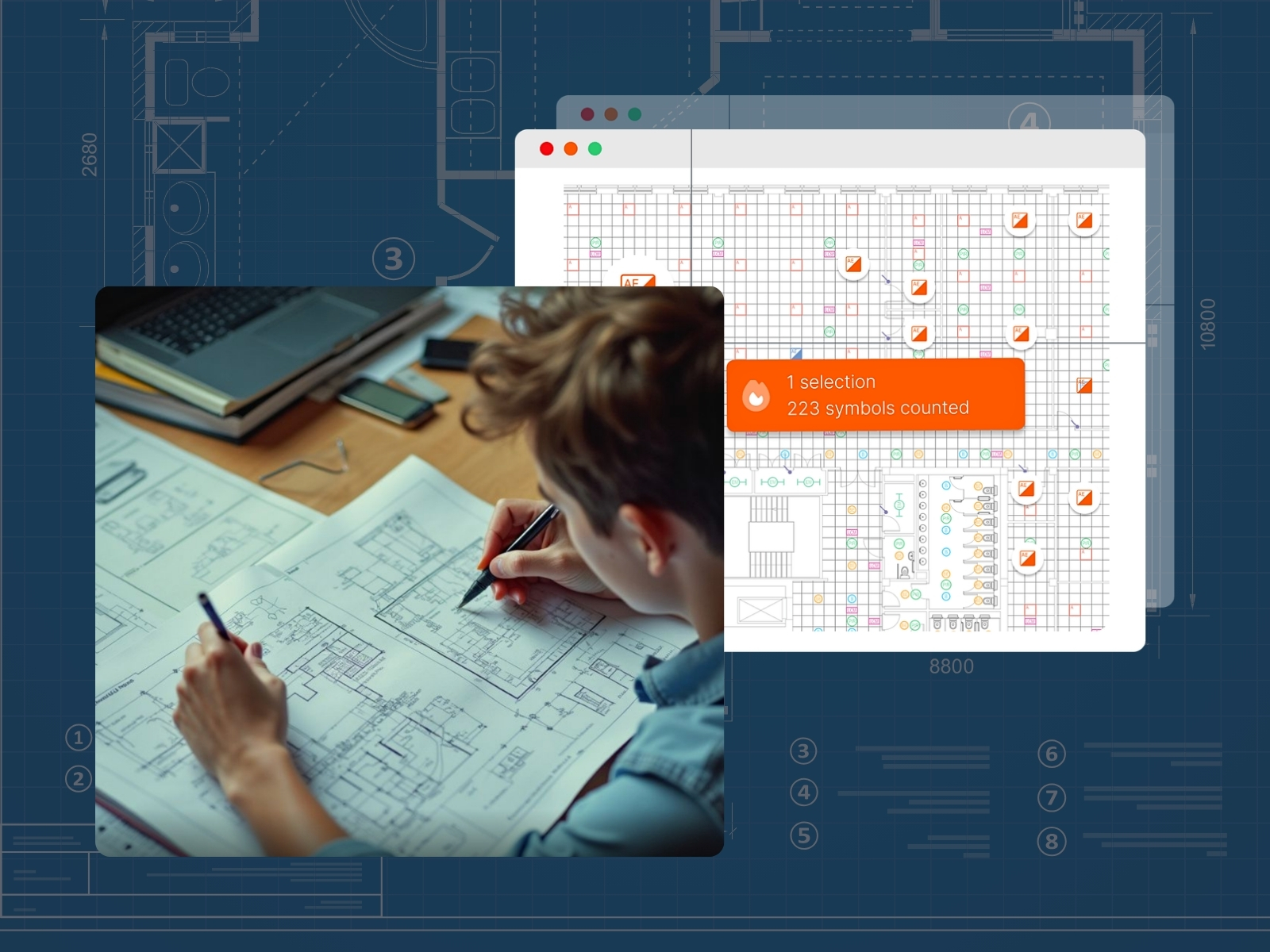
Most electrical estimators don't lose tenders on bad judgement. They lose them on a missed symbol on page 47 of a 60-page drawing, a mis-counted circuit, or a revision that wasn't caught in time.
The method you use to produce your electrical takeoff has a direct bearing on how often those errors occur, and how quickly they can be corrected. This article breaks down how manual and automated approaches compare on accuracy, speed, and reliability, so you can make an informed decision about where your estimating process stands.
An electrical takeoff is the process of quantifying every electrical component required to complete a project; from containment and cabling through to sockets, light fittings, panels, and accessories. Estimators work through drawings (typically PDFs or CAD files) to produce a bill of quantities that feeds into a tender price.
The accuracy of that count directly affects your margin. Over count and you price yourself out; under count and you win work you'll lose money on.
Tender pricing is competitive and often tight. A 5% error in your quantities can mean the difference between a winning price and an undeliverable one. Clients increasingly expect detailed, itemised submissions, and estimators who can demonstrate accuracy in their estimates build credibility as well as margin.
Most estimating teams fall into one of three workflows:
Manual takeoffs are still common, particularly in smaller companies. And for low-complexity projects, they can work. But as project scale, drawing sets, and tender volumes grow, the limitations become harder to manage.
Counting symbols manually, even with PDF markup tools, is inherently easy to get wrong. On a commercial project, a single drawing might contain hundreds of identical symbols. Fatigue, interruption, or a cluttered drawing layer can result in missed items. Those omissions only become visible once work is on site.
Research into estimating accuracy consistently points to human error as the primary source of takeoff mistakes. The problem is not competence; it’s the process.
Tender windows rarely give estimators the time they need. When a deadline is tight, a manual takeoff of a large drawing set can occupy most of that window, leaving little time for sense-checking, value engineering, or competitive analysis.
Speed pressure compounds error risk. When estimators are rushing, corners get cut.
Drawing revisions are a routine part of the tender process. With manual takeoffs, each revision typically requires a full or partial re-count. There is no systematic way to identify exactly what has changed between drawing versions, which means estimators either re-do significant amounts of work or accept the risk of working from stale quantities.
On projects with multiple revision cycles, this can absorb a substantial proportion of an estimating team's capacity.
Automated takeoff tools use symbol recognition technology to identify and count electrical components directly from PDF drawings. Rather than replacing the estimator's judgement, they remove the repetitive counting task and surface the data estimators need to make decisions.
Modern takeoff software processes PDF drawings as-uploaded, no conversion or preparation required. The software analyses the drawing and identifies symbols based on shape and pattern recognition.
Once a symbol type is defined, such as a twin socket, a fire alarm device, or a luminaire, the software scans the drawing set and returns a count. This takes seconds rather than hours, and the results are auditable: every instance is flagged on the drawing so the estimator can verify the output.
Cloud-based platforms allow multiple estimators to work on the same project simultaneously, with counts updated in real time. Project data is accessible from any device, which matters as hybrid working becomes standard.
This is where the practical difference is most significant.
Studies comparing manual and automated counting across electrical drawings consistently show error rates of 5-15% in manual takeoffs. Automated tools, when properly configured, reduce this to near zero for the counting task itself, the remaining margin for error shifts to symbol setup and drawing quality, both of which are controllable.
For a £500,000 electrical package, a 5% quantity error represents £25,000. That is the cost of inaccuracy.
When a drawing is revised, automated software can re-run the count against the updated file and flag discrepancies between versions. Estimators see exactly what has changed, such as new symbols added, or items removed, without re-counting from scratch. This makes revision management systematic rather than manual.
On multi-building or phased projects, manual counting introduces cumulative risk: each drawing counted separately by potentially different team members, at different points under different time pressures. Automated software applies the same logic consistently across every drawing in the set.
Accuracy matters, but so does throughput, particularly for firms tendering across multiple projects simultaneously.
A takeoff that takes a senior estimator two days to complete manually can typically be completed in a few hours using automated software. The time saved is not just in counting; it is in verification, revision management, and output formatting.
Companies that have moved to automated takeoffs regularly report being able to handle significantly higher tender volumes without adding headcount.
Faster takeoffs mean earlier visibility of quantities, which gives more time for supplier engagement, subcontractor pricing, and commercial review. Submitting a well-priced tender on time is more achievable when the quantification stage is not consuming most of the available window.
One of the less-discussed advantages of automated takeoffs is their ability to run parallel projects. A team using manual methods can realistically work on one or two active tenders at a time before quality suffers. With automated tools, the bottleneck shifts from counting to commercial judgement, which is where estimator expertise is actually needed.
Automation is not universally necessary.
For very small, simple projects, for example a single-floor fit-out or a straightforward residential rewire, a manual takeoff may be entirely appropriate. The overhead of setting up a new project in software may outweigh the time saved.
Manual methods also remain viable when drawing quality is poor, non-standard, or heavily hand-annotated, and symbol recognition would require significant correction.
The decision should be based on volume, complexity, and margin sensitivity. As any of those increase, the case for automation strengthens.
The shift toward automated takeoff tools is not driven by technology for its own sake. It is driven by commercial pressure: more tenders, tighter margins, faster deadlines, and clients who expect detailed submissions.
Estimators who can produce accurate, auditable quantities quickly have a structural advantage in the tender process. They can price more work, price it more accurately, and spend their estimators' time on the decisions that actually require expertise, rather than on counting.
For growing electrical contractors, the question is less "should we automate?" and more "how much is manual counting costing us?"
Manual takeoffs are not inherently wrong. But they carry a cost: in time, in error risk, and in the capacity constraints they impose on your estimating team. If you're counting symbols by hand on your next tender, run one drawing through Countfire first. Most estimators find it takes minutes to see the difference.
Automated electrical takeoff software does not replace estimators. It removes the task that is most susceptible to human error and most wasteful of skilled time so estimators can focus on winning work profitably.
If your team is counting symbols by hand on commercial or industrial projects, it is worth understanding what that process is costing you in hours and in tender accuracy.
Countfire is electrical takeoff software built for estimators. Find out how it compares to your current process and start your free trial today.
.jpg)
For electrical estimators, the estimating stage is where commercial risk is either controlled or created. This article covers the most common sources of error, and the practical steps you can take to reduce them.

.jpg)